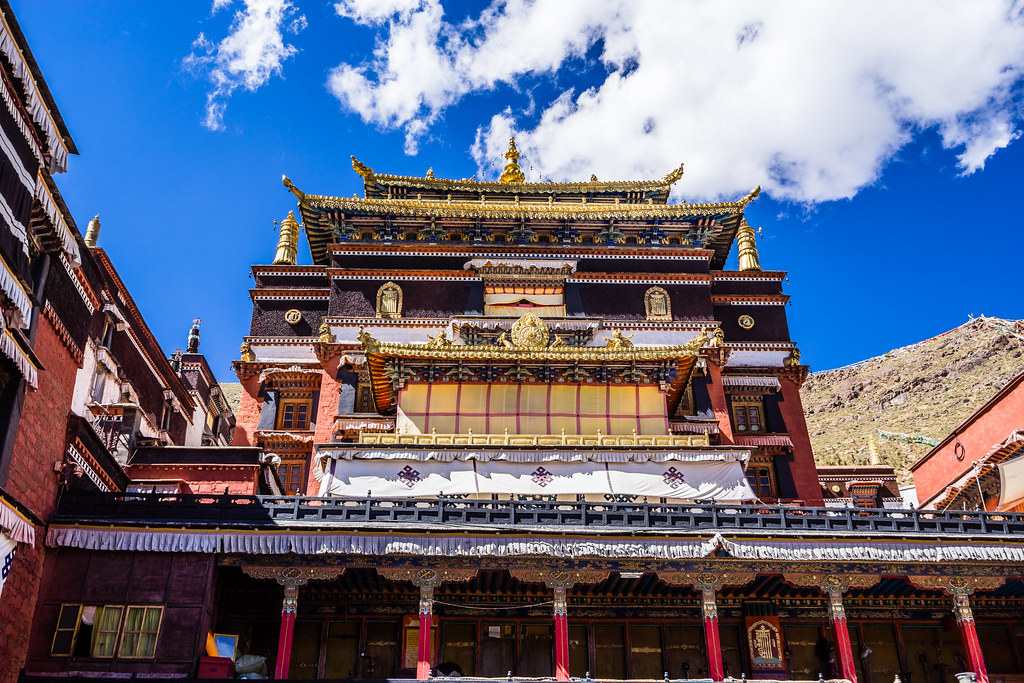
What to see here
Tashilhunpo sits at the foot of Niser hill on the west side of Shigatse, founded in 1447 by Gendun Drup. It is the largest monastery in Tsang and the seat of the Panchen lamas, spread up the slope in white walls, gilded roofs and the great thangka wall — two to three hours to walk properly.
The Maitreya hall is the first stop. The building rises about thirty metres and holds a seated Maitreya cast in bronze at over twenty-six metres, the largest of its kind, made in 1914 under the ninth Panchen lama with great quantities of copper and gold and gems set between the eyebrows.
The reliquary chapels of the Panchen lamas are the other: silver-clad stupas set with pearls and stones, butter lamps burning year-round. Murals, thangkas and woven banners are well kept, and the halls are dim — take your time. From the upper terraces the whole of Shigatse and the Nyang valley open below.
The story behind this place
Tashilhunpo belongs to the expansion of the Gelug school. Gendun Drup, a disciple of Tsongkhapa later recognised as the first Dalai Lama, founded the house as the root seat of Tsang; the fourth Panchen, Lobsang Chokyi Gyaltsen, enlarged it heavily, which is when it took its present scale.
The Maitreya statue carries the best story. The ninth Panchen lama raised funds for years, copper and gold arriving from across the region, and once cast it became one of the most venerated images in Tsang. Older monks say that on the day it was finished the whole town came with lamps, the queue running from the gate to the river.
Driving there and visiting
The monastery is inside Shigatse with a car park at the gate where a foreign-plate car can stop. From Lhasa via Yamdrok and Gyantse it is about six hours on good roads, and the old town and the Nyang river are close by afterwards.
- Buy the ticket at the gate, real-name on your passport. Most halls forbid photography; the Maitreya and reliquary chapels are absolute.
- The route enters on the left and runs clockwise, two to three hours. You can climb to the thangka wall, but the steps are steep.
- Hats and sunglasses off inside, no noise, and do not step over offering tables or move offerings.
- Morning gives the best light and the fewest people; tour groups arrive after lunch and the Maitreya hall queues.
- The old streets outside are worth a walk for incense and wool; bargain as usual, and do not block the lane entrance with the car.
- At 3,840 m there is a lot of up: slow pace, water with you.
Pairing it with nearby stops
Tashilhunpo is the core of Shigatse and takes half a day; the new Panchen palace and the Nyang river fill the rest. On the Everest route Shigatse is the natural halfway stop — the monastery in the morning, Tingri in the afternoon.