What to see here
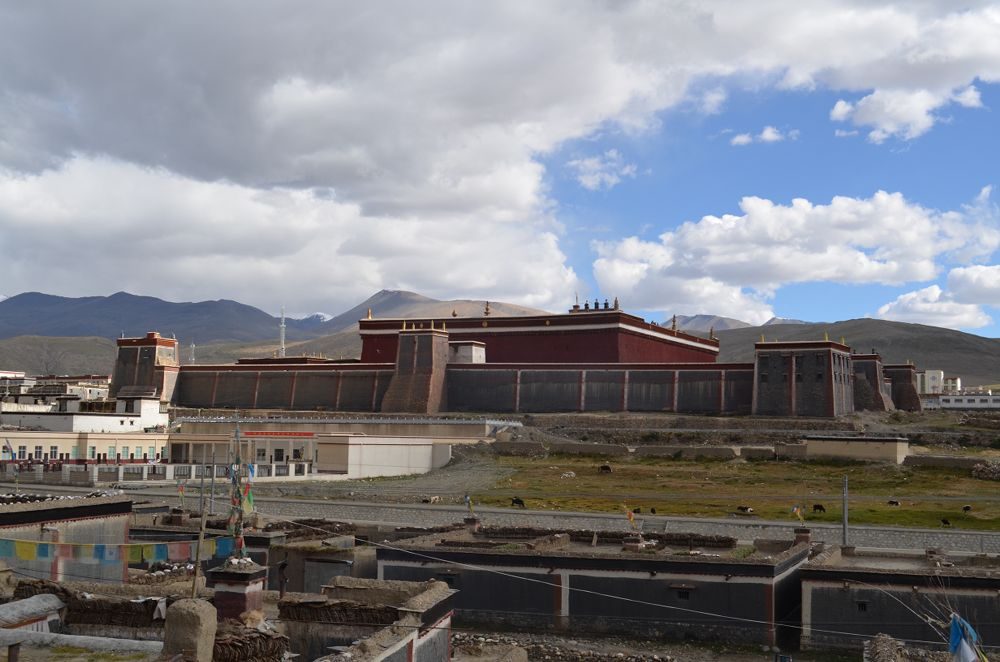
Sakya lies in Sakya County about 160 km southwest of Shigatse at over 4,300 m and is the mother monastery of the Sakya school. It comes in two parts: the northern house on the slope of Ponbo Ri, ruined in the late Yuan wars and now a field of broken walls, and the southern house on the flat, a square fortress over two hundred metres on a side with grey, white and red vertical bands painted on its walls.
The colours carry meaning: red for Manjushri, white for Avalokiteshvara, grey-blue for Vajrapani — which is why the Sakya school is nicknamed the “flower teaching”. Battlements and towers run along the top and there is a single gate on the east side; inside, it feels like entering a town.
The scripture wall in the southern house is the shock of the visit. The whole western wall of the great hall is filled with volumes stacked to the heights, tens of thousands of them by local count, many in Yuan-era manuscript. Murals, porcelain and statues of the same period fill the halls — the density of objects is why it is called a second Dunhuang.
The story behind this place
The rise of Sakya is tied to the Khon family. In 1073 Khon Konchok Gyalpo saw a patch of earth on the south side of Ponbo Ri that was pale and gleaming, read it as an auspicious sign, and built there; the school grew around the house and in the Yuan period became the dominant religious and civil power in Tibet.
The monastery tells the story of Phagpa. A Sakya hierarch, he was made imperial preceptor at the Yuan court and devised the Phagpa script; the link with the Yuan made this remote valley a centre of politics as well as religion. Most of the Yuan material preserved here dates from that period.
Driving there and visiting
From Shigatse the road to Sakya runs 160 km on pavement, the last stretch following the valley into the small town. The monastery sits in the town with a car park at the gate where a foreign-plate car can stop.
- At over 4,300 m, five hundred above Shigatse: walk slowly. The northern ruins are up on the hill and windy — do not climb too far.
- Buy the ticket at the gate, real-name on your passport. No photography inside; the scripture wall may be looked at, not touched.
- Railings run along both sides of the scripture wall. Stay on the path; a small torch helps in the dim halls.
- The path up to the northern ruins is gravel and slippery after rain; wear grippy shoes and do not linger at broken walls.
- The town has simple restaurants and guesthouses; the fuel station is at the entrance, so fill before you go in.
- The kora around the monastery runs clockwise; give way to local elders.
Pairing it with nearby stops
Sakya folds into the Everest line: on the way back from Tingri to Shigatse, divert for half a day here; or take Sakya first on the way out and continue to Tingri. Either direction works without backtracking.