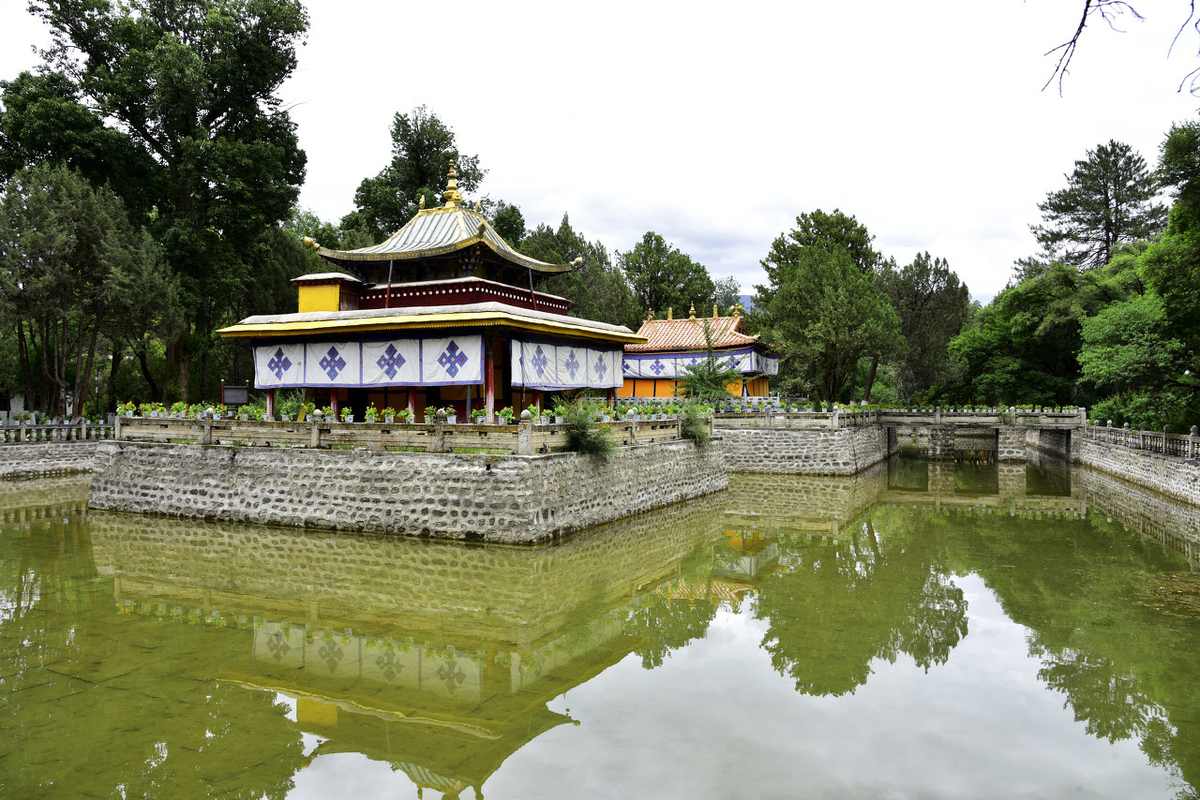
What to see here
Norbulingka means “the jewel garden”. West of central Lhasa and covering some 36 hectares, it is the largest man-made garden on the plateau. From the eighteenth century each Dalai Lama moved here from the Potala for the summer, running the administration from the park until the ninth Tibetan month brought him back — a practice that lasted into the mid-twentieth century. It joined the World Heritage List in 2001 as an extension of the Potala.
Three palace groups are worth the time. Kelsang Potrang is the oldest, the core of the seventh Dalai Lama's day; Golden Potrang has gilded outer walls and the grandest mass, built under the thirteenth; Tagten Migyur Potrang is the new palace of the fourteenth, with walls of murals tracing Tibetan history and the lineages — read panel by panel and it takes a long while. Between the palaces lie lawns, ponds, trees and pavilions, and walking eats more time than the halls.
This place feels less like a monastery than a large public garden. Local families come in order to sit down: a rug on the grass, sweet tea, potatoes, dried meat, and a whole day gone. That is what norgyepa, a park day out, means. To see how the city lives rather than how it built, come here.
The story behind this place
The park began, by the usual account, with the seventh Dalai Lama bathing at a spring on this ground in summer and having the first palace built beside it — Kelsang Potrang. Each later incarnation added something, the garden growing until woods enclosed palaces and palaces enclosed courtyards.
Shoton is the busiest week of the year here. At the end of the sixth and start of the seventh Tibetan month the whole city pours in, tents go up on the lawns and opera troupes perform in rotation from morning to night. The festival began as the close of the monasteries' summer retreat and turned into a public gathering, with Norbulingka as its main stage.
Driving there and visiting
Norbulingka sits on the west side of the city with a proper car park at the gate, and a foreign-plate car can drive up and park — the easiest of any sight inside Lhasa. It is three kilometres from the Potala on good roads; arrive early for a space.
- Buy the ticket at the gate, real-name on your passport. The park is large: two to three hours on foot, so wear soft shoes.
- Photography is allowed in most palace interiors but flash is not. Murals and statues have railings — do not step over them.
- During Shoton the crowds are heavy and the car park fills by mid-morning. Take a taxi or walk in rather than drive.
- There are snack stalls and toilets inside but they are far apart; sort that out before entering. Summer sun is fierce: hat and water are essentials.
- You may sit on the grass, but keep off flower beds and fenced maintenance areas, and carry your rubbish out.
- Good with children: flat ground, deep shade, and somewhere to sit whenever legs get tired — far easier than the Potala stairs.
Pairing it with nearby stops
Norbulingka and the Tibet Museum are next door: the garden in the morning, the museum after lunch, the shortest possible transfer. If you put the Potala on the same day, run it Chokpori at dawn for the front view, the palace in the morning, then Norbulingka to rest in the afternoon — the most even split of energy.