What to see here
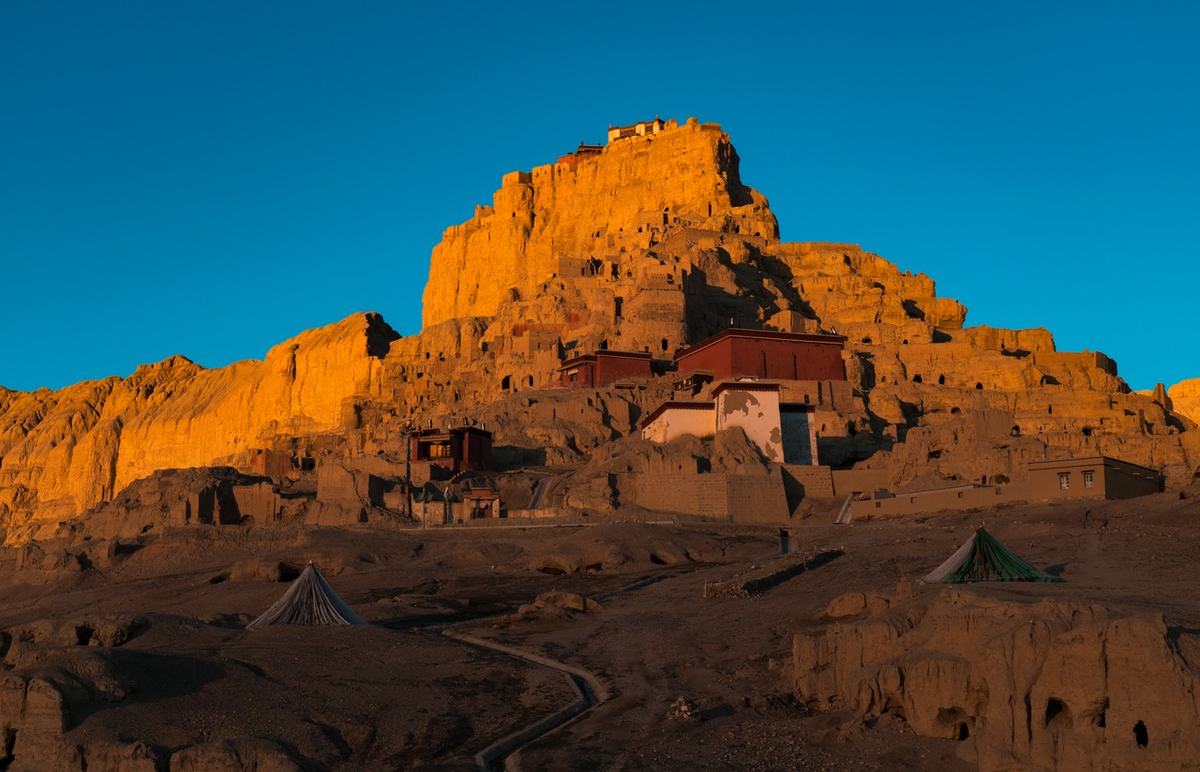
The Guge ruins climb an earth hill west of Tsada town at about 3,800 m, with the Langchen Tsangpo running below. The whole hill is built over: the palace at the summit, the red hall, white hall and Tara chapel halfway up, and below them dense caves, watchtowers and passages cut into the earth.
The murals in the red and white halls are the reason to come. The red hall's walls are crowded with the Buddha's previous lives and royal donors in deep colour; the white hall is more ordered, finer in line and better preserved. The interiors are very dark — torch, never flash.
The site is bigger than expected. A full walk on the paths takes two to three hours, and from the summit the whole badland and the valley below open out. In the caves at the foot you can still read the marks of habitation, hearths and niches in the walls.
The story behind this place
Guge was founded in the tenth century and collapsed in the seventeenth, three hundred years in between. Its beginning is tied to the descendants of Langdarma, the last Tubo emperor: one branch moved west to Ngari and founded the kingdom, reintroduced Buddhism and left the monasteries and murals behind.
Several accounts explain the end: war with Ladakh and the royal family taken after the city fell; internal religious conflict leading to siege and revolt; or the water supply cut until the city could not hold. Which was decisive is still unsettled, but the half-burnt beams and scattered arrowheads in the ruins show that in the end someone fought their way in.
Driving there and visiting
From Tsada town the ruins are a dozen kilometres on pavement and dirt, the last stretch climbing to the car park. A foreign-plate car can reach the car park; inside the site you walk.
- Buy the ticket by the car park, real-name on your passport. The paths run in sections — follow the signs, do not cross railings.
- At 3,800 m the slope and steps still tell: walk slowly, and it is windy on the summit, so hat and jacket.
- No photography, no flash, no touching the murals. Do not go deep into the caves; some ceilings are unstable.
- An hour before sunset is the best light, the badlands turning gold-red — the shot of the site.
- Carry water; there is nothing inside the site and toilets only at the car park.
- Add Tholing monastery nearby, whose murals belong to the same period — the comparison is worth it.
Pairing it with nearby stops
Guge, the Tsada badlands and Tholing make one group: the badlands and monastery in the morning, the ruins after lunch, the golden hour from the viewpoint. The roads are long — stay a night at Tsada rather than driving back the same day.