What to see here
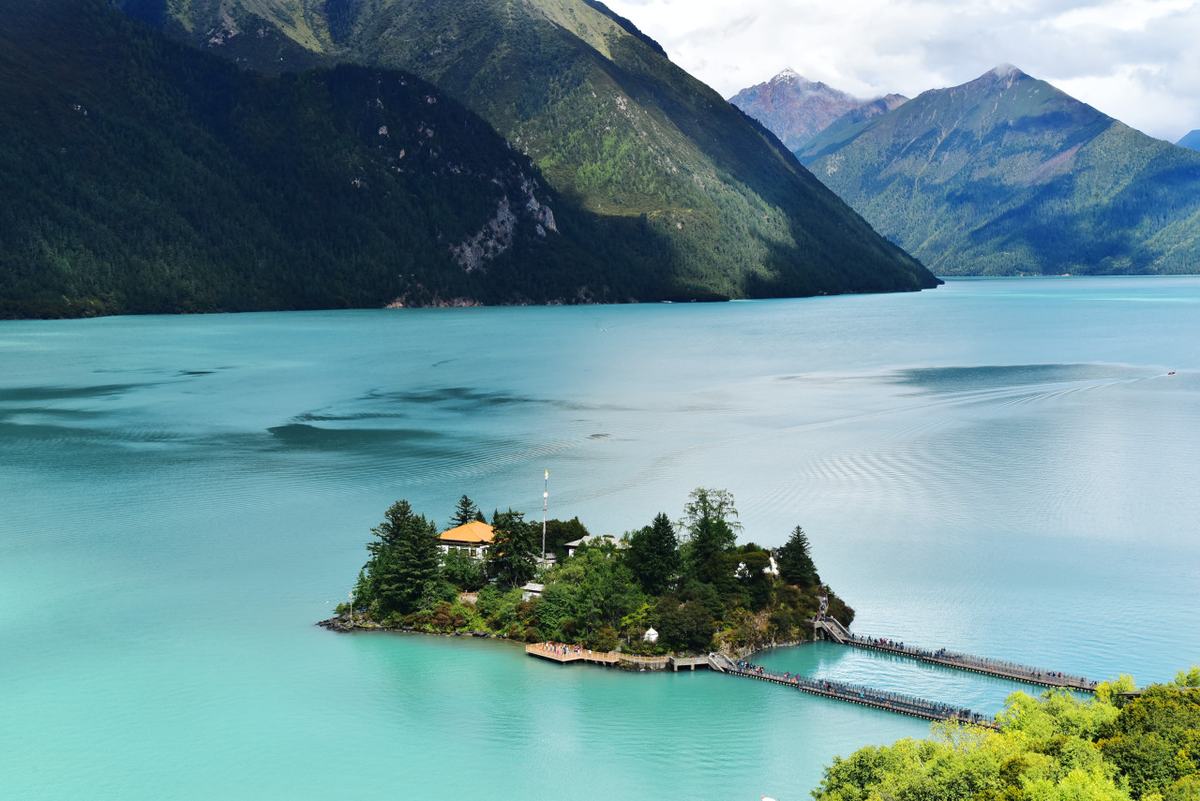
Basum Tso lies in Gongbo'gyamda County in Nyingchi at 3,480 m, one of the few turquoise lakes in Tibet and a sacred lake of the Nyingma school. It runs for a dozen kilometres, ringed by spruce and pine, with hill shadows lying on the water and a colour deeper than most photographs.
The island is the famous part. It sits a few dozen metres offshore, joined by a wooden walkway, and carries Tsongkha monastery — the name means “castle in the lake”. The hall is small but holds the Nyingma deities, and an old pine growing out of a peach tree stands at the island edge. The circuit of the island is only a few hundred metres, yet it is the densest place of practice on the lake.
Two more stops: Jeba village on the east shore, an old Kongpo settlement of timber and stone houses with barley drying frames, where you can sleep and eat; and Cuogao further in, quieter, sitting between meadow and stream. A lakeside kora path takes two to three hours and is best in autumn.
The story behind this place
Tsongkha has two accounts of its origin: one places it in the Tubo period more than 1,500 years ago; the other attributes it to the Nyingma master Sangye Lingpa in the fourteenth century. The name “castle in the lake” is the version told most locally, and it suits the shape of the island.
Folk tradition explains the lake as a valley whose outflow was blocked by a mountain deity with stones until the water rose. A strange-shaped rock on the shore, the “prayer-for-children hole”, is touched and circled by couples hoping for a child — a custom still alive.
Driving there and visiting
From Lhasa on the Nyingchi expressway to Gongbo'gyamda, then into the valley to the lake, all paved, a little over four hours; from Nyingchi only an hour. A foreign-plate car can reach the car park at the gate, with shuttle or walking beyond.
- At about 3,500 m this is the least likely place in Tibet to trigger altitude sickness. If Lhasa hits you hard, put Basum early in the trip.
- Buy the ticket at the gate, real-name on your passport. Spaces are tight in high season; arrive early.
- Weather turns fast and rain arrives without warning: bring a waterproof shell, and the walkways get slippery.
- Part of the kora path hugs the water; do not use it when the lake is high. The road circuit is safer.
- Jeba village has rooms, simple but clean — book ahead. Meals in the village are home cooking.
- No nets and no swimming in the lake; carry all rubbish out.
Pairing it with nearby stops
Basum slots into the Nyingchi route: from Lhasa, overnight at Gongbo'gyamda or Jeba, then the lake and island the next morning before Nyingchi and Lulang. Coming in from Nyingchi, Basum is the first stop and the low altitude helps acclimatisation.