What to see here
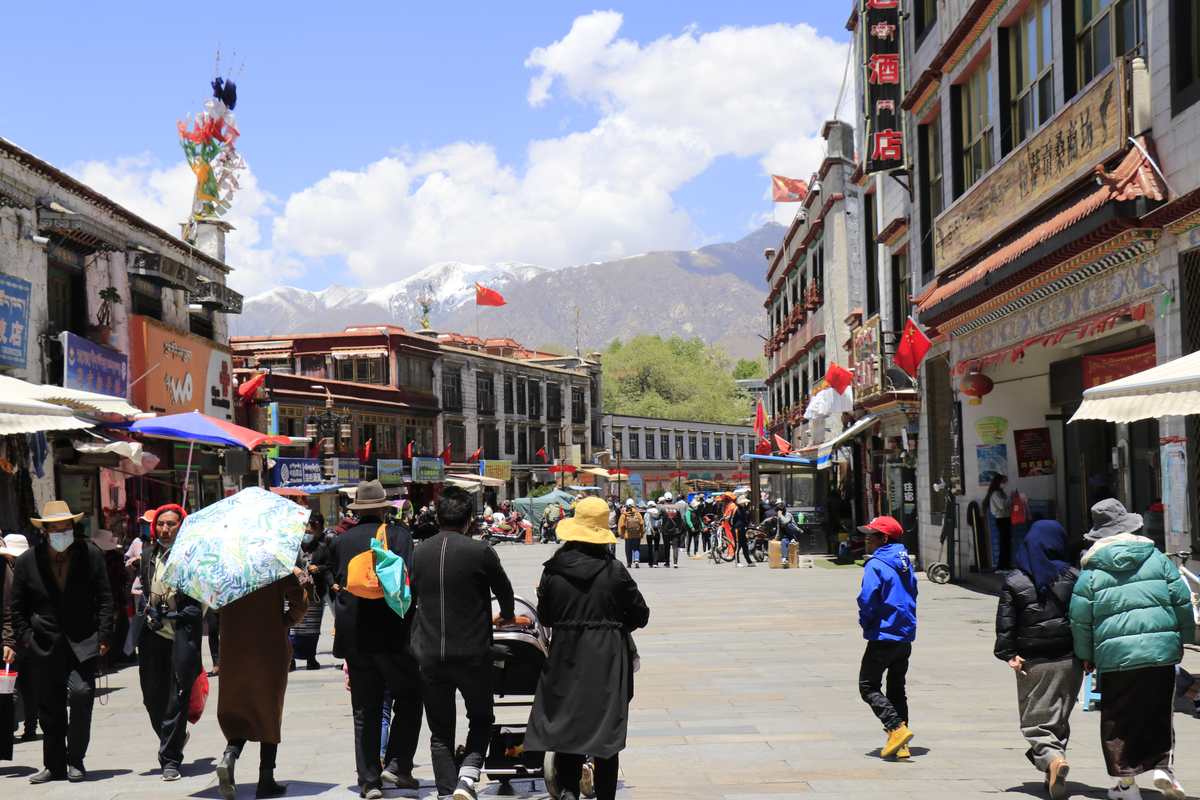
Barkhor is not a single street but the kora ring around the Jokhang, about 1.2 km for a full circuit of flagstone, old walls and Tibetan windows, lined with shops on both sides. It is also the skeleton of old Lhasa: dozens of lanes radiate out from the ring, with Chongsaikang market, Dongzisu Road and Dajielin Road close by. Go into the lanes to see how the city actually lives.
Three things are worth your attention. First the flow of pilgrims itself — old people with prayer beads, prostrators, people carrying butter — circling without end, the densest concentration of practice anywhere in Tibet. Second the old buildings on the ring, including the yellow house of Makye Ame and the former residence of the Qing resident minister. Third the crafts: thangka workshops, incense shops, wool and silver work, all done in front of you.
Do not rush the street. Morning is the busiest and best for watching the kora; shops are fully open after lunch if you want to buy; in the late afternoon the light rakes across the old walls and prayer flags. When you tire, sit in any sweet tea house with a pot of tea and a bowl of Tibetan noodles — half an hour there is worth more than another sight.
The story behind this place
The best-known story here belongs to the yellow house and the sixth Dalai Lama, Tsangyang Gyatso. Folk accounts say he slipped out in disguise to walk these lanes and met a girl called Makye Ame, leaving behind the love songs that are still sung. The house is a restaurant now and nobody argues about the facts, but Lhasa people soften when they tell it.
The other story is in the paving. Barkhor runs clockwise because the kora must follow the sun, a rule unchanged for centuries. Older residents describe the street as the old staging ground for mule trains and traders — Khampas, Nepalese merchants and tea caravans from the Chinese interior exchanging goods here, wearing the stones smooth.
Driving there and visiting
Barkhor is pedestrian and closed to vehicles on all sides, so a foreign-plate car stays outside. The car parks along Yutok Road and Jiangsu Road are the handiest, five to ten minutes on foot. The lanes are tight and navigation often routes you into a dead end; better to walk the extra distance than to force a turn.
- Always walk the kora clockwise. Follow the flow, do not walk against it, and do not cut across the line to take a photo.
- Prostrators keep to fixed spots. Walk around their mats. If you want a portrait, raise your hand first and ask; do not push a lens into someone's face.
- Thangkas, incense, wool and turquoise are all negotiable. Ask the price before handling anything, and do not buy poor-quality pieces as antiques. Expensive stones need a certificate — no certificate, no deal.
- Chongsaikang market on the north side of the old town sells household goods, butter and dried fruit at honest prices, well below the tourist shops.
- Watch your bag: dense crowds also carry pickpockets. Winter is windy and bright, so bring a hat and water.
- Do not load purchases straight into the back of the car — drop them at the hotel first, then go out for a second lap.
Pairing it with nearby stops
Barkhor naturally pairs with the Jokhang: circle the street, enter the temple, then push north into Chongsaikang, and come back at dusk for the lamps. With half a day, do the street and the temple. With a full day, take the Potala in the morning and Barkhor with a tea house in the afternoon, returning to the square in the evening for the prostrators.